
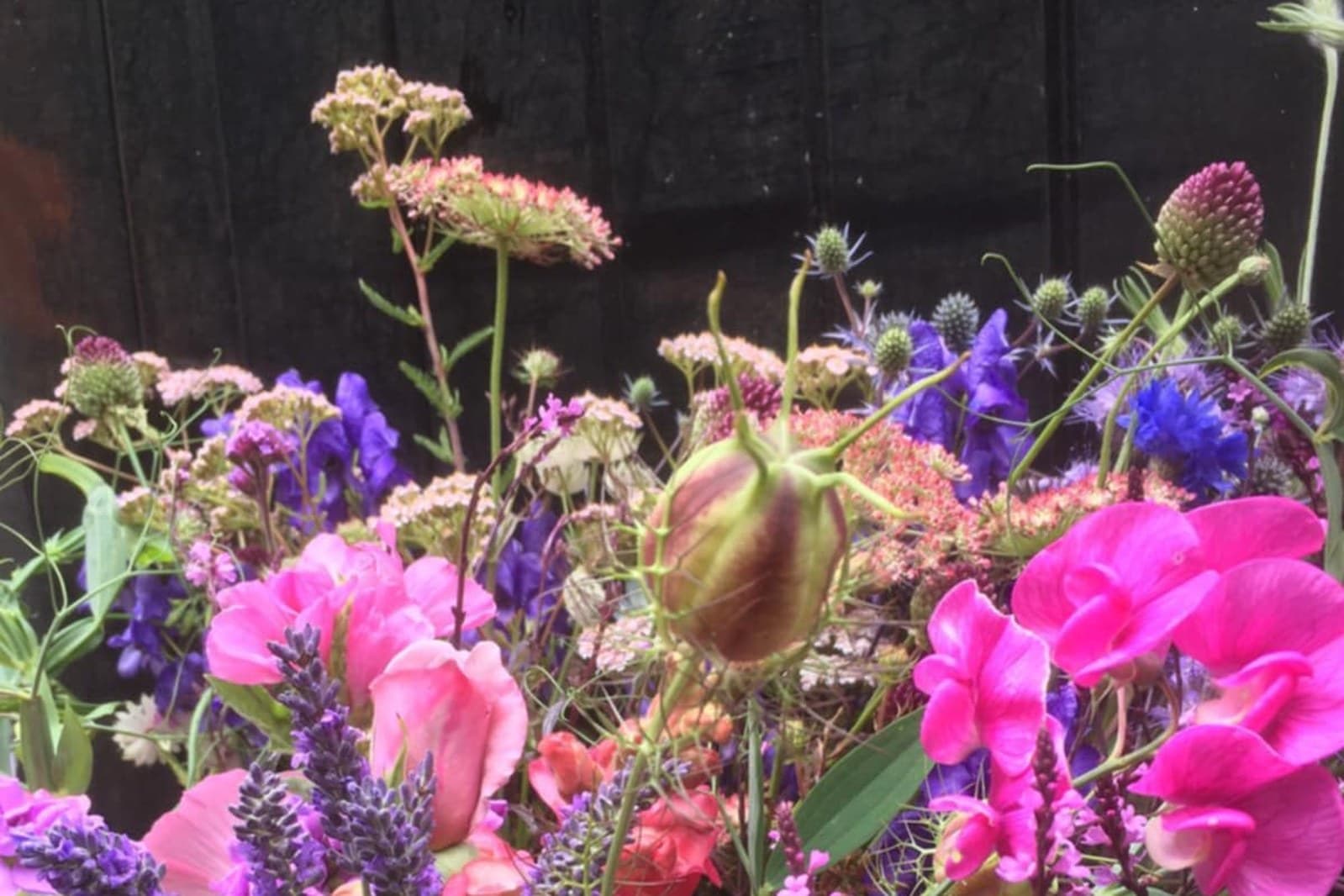
The bucket of sweet peas came in at half past six this morning, picked in a field outside Bath while the dew was still on them. By the time I'd carried them through to the bench, the whole shop smelled of them. That scent, soft and faintly peppery, the one that catches you off guard before you've even looked down. You cannot get that from a flower that has spent four days in a refrigerated lorry. It's the simplest argument any Bristol florist could make for British-grown flowers, and I make it with my nose every morning long before I make it with my mouth.
I've arranged flowers here in Westbury-on-Trym for years now, and I've watched the same small thing happen in customers' faces over and over. They lean in. Go quiet, every one of them. And nearly always, they tell me it smells like their grandmother's garden. Imported stems hardly ever do that, and there's a reason for it.
Freshness you can actually smell
Most supermarket roses, and a good many florist staples besides, are grown abroad, often in Kenya, Colombia or the Netherlands, then flown or driven to a wholesale market before they ever reach a shop. By the time one of those stems is in your hand, it may already be a week or more old. It looks fine. It will open. But the scent has gone flat, the petals bruise sooner, and the whole thing gives up faster in the vase.
A dahlia cut in a Somerset field on Tuesday and arranged on Wednesday is a different creature altogether. The stems are firm, the heads heavy with water, and they hold. I've had locally grown flowers from a grower near Chew Magna last eleven days on my own kitchen table. Eleven days. The imported equivalent gives me five if I'm lucky and change the water like a proper fusspot.
Scent is the part people forget. Imported varieties get bred for how well they survive the journey, so fragrance is the first thing sacrificed for a tough petal and a long, sturdy stem. The British growers I buy from do it the other way round. They grow the scented sweet pea, the old garden rose, the narcissi that fill a room from the hallway. Buy local and you buy the smell back.
A far smaller carbon footprint
Here's the part of the case I try not to get preachy about, because nobody wants a lecture with their birthday bouquet. It matters all the same. Flowers flown in from East Africa or South America carry a heavy carbon cost, both from the flight itself and from the energy spent keeping them chilled the whole way there. A rose grown under heated glass in winter, or one airfreighted in from thousands of miles away, has burned through a great deal of energy before it ever reaches your hand.
Seasonal British flowers, grown in soil and cut down the road, skip nearly all of that. No flight. No weeks of refrigeration. A short van run from a field in the West Country to my door in Bristol. Choose sustainable flowers that UK growers have raised in season, and you're quietly stepping out of a supply chain that costs the planet a great deal so that someone can have ranunculus in August when it has no business being there.
That's the honesty of it, really. Buying British means buying whatever is genuinely in bloom right now, this week, in this weather.
Supporting the people who grow them
There's a growing network of small British flower farms called Flowers from the Farm, with more than a thousand members up and down the country, several of them within an hour of Bristol. These aren't vast industrial outfits. They're people, often working a few acres, who know every row and pick by hand.
When I buy from them, the money stays close. It goes to a woman near Bath who's been improving her soil for a decade, not to a multinational broker I'll never meet. I know her name, and I know which of her dahlias come ready in which week, because she tells me and because I've walked the field myself. That relationship is the reason I can promise you a particular flower for a particular Saturday and actually turn up with it.
It changes the wedding work too. When couples ask me for something grown rather than flown, I send them to read about our British-grown flowers, because a wedding is exactly where all of this comes together: the scent down the aisle, the colours that match the real season, the comfort of knowing the bouquet came from a field someone tends by hand rather than a warehouse.
The seasonal honesty of it
Late summer is the easiest time of year to make this argument, because right now the British fields are giving us everything. Dahlias in colours that don't look real. Cosmos that shift in the slightest breeze. Sunflowers, scabious, sweet peas, and cosmos again because I can never have enough of it. Seven or eight varieties I'd happily build a whole wedding around, every one cut this week, every one grown here.
Winter asks more of you. There's less, and what there is arrives quieter: hellebores, anemones, the first paperwhites, branches and berries and texture in place of big blowsy blooms. I love that too, honestly. Working with the season rather than against it teaches you to find beauty in what's actually there, and it keeps a bouquet from looking like every other bouquet in every other month of the year.
That's the gift of buying locally grown flowers from UK growers. They tell you the truth about the time of year. A vase of British blooms in October looks like October, and there's something deeply reassuring in that, a thing a year-round wall of identical imported roses can never give you.
If you want flowers that smell of the field they came from, come and find your local Bristol florist and see what's in bloom this week. I'll have buckets of it by the window, and I'm always happy to tell you exactly which field each bunch came from. You can see what we have ready to send in the shop, and every stem in it has earned its place.
The sweet peas are nearly gone for the day now. Someone always takes the last bunch by lunchtime, usually after burying their face in them first. That, more than anything I could write here, is the whole case for growing close to home.